Packaging and Packaging Waste Regulation (PPWR): *Updated on 25 August 2026
*The information on this page is provided for general informational purposes only. While we compile and update the content with due care, no rights or claims may be derived from it. Ongoing developments in legislation and regulation may result in changes to the information provided. For the most up-to-date, complete, and legally binding requirements, please always refer to the final Regulation, the related secondary legislation, and the officially published documents of the European Union.
On 11 February 2025, the PPWR (Packaging and Packaging Waste Regulation) was published. The aim of this legislation is to reduce packaging waste, make packaging more circular, promote the use of recycled materials, restrict harmful substances, and at the same time create a single harmonised European market for packaging.
This legislation will have an impact across the entire value chain. Therefore, we believe it is important to actively inform our customers about these developments, as also required by law under Article 16.
THE TIMELINE
Despite the fact that the legislation was published as early as the beginning of 2025, various articles and guidance documents are still being further specified. An overview of the timeline to date is provided below.
A transition period of 18 months was established to allow governments and businesses to prepare.
- All measures for which no alternative application date is specified will apply 18 months later, on 12 August 2026.
These documents provide clarification on PPWR articles and provisions that had previously raised many questions. Although the guidance documents have not yet been formally adopted, this is expected to take place in the near future, after which official publication will follow.
Guidance documents are not legally binding. However, they may influence the interpretation of definitions and obligations. It is therefore advisable to use the PPWR itself as the primary reference and the guidance documents as support when interpreting its provisions.
On 12 August 2026, the first obligations under the PPWR will enter into force, including the requirements relating to substances of concern in packaging (Article 5: Substances of Concern). From that date onwards, producers (our customers) must have a declaration of conformity and technical documentation demonstrating compliance with these requirements. As a supplier, we have an obligation to provide information to our customers.
Design requirements: packaging must be recyclable
Substance restrictions: substances of concern, heavy metals and PFAS restrictions (for various applications)
Technical documentation
- Material specifications
- Technical data sheets
EU Declaration of Conformity (DoC)
Per packaging type (to be prepared by the packaging producer).From this date onwards, products that do not comply with these PPWR requirements may no longer be placed on the market.
Publication of the following elements under Article 7:
- Calculation, verification and reporting of PCR content
- Methodology for assessing the sustainability of recycling processes
- Article 6: Design for Recycling criteria
- Article 10: Packaging minimisation assessment
- Article 11: Technical criteria for reusability
- Article 12: Harmonised labelling
- Article 29: Methodology for calculating reuse targets
From this date, harmonised labelling requirements are expected to become mandatory across the European Union (Article 12). The objective is to create a universal European system for providing information on packaging composition and the correct method of waste sorting. Through the use of standardised symbols and waste-sorting instructions, it should become easier to correctly collect and recycle packaging.
This marks the next major milestone. From that date onwards, several sustainability requirements for packaging will become applicable, including requirements relating to:
- Design for Recycling (Article 6): packaging must comply with the European design criteria for recyclability.
- Minimum recycled plastic content (Article 7): certain plastic packaging formats will be required to contain minimum percentages of post-consumer recycled (PCR) content.
- Packaging minimisation (Article 10): packaging must not contain more material than necessary to fulfil its intended function.
- Recyclability performance grades: packaging will be assessed and classified according to its recyclability based on harmonised European criteria.
This is only a selection of the most relevant obligations and measures included in the timeline. For the exact requirements and the most up-to-date developments, please refer to the official legislation and related publications.
At the bottom of this page, we highlight the key topics and articles of the PPWR that are relevant to both us as a packaging supplier and the customers we work with.

SUPPORTED BY PROFESSIONAL
PARTNER FOODCHAIN ID
Our professional partner FoodChain ID supports and advises us in preparing for compliance with the PPWR legislation. Together, we are working on the development and implementation of the required information systems, documentation and declarations.
CONFORMITY & SUPPORTING DOCUMENTATION
Our objective remains unchanged. We aim to comply with the PPWR obligations applicable to us from 12 August 2026 onwards. It is important to understand that there is a distinction between being compliant and having a fully developed compliance dossier.
Over the past period, we have focused on establishing the minimum required supporting documentation, technical records and declarations to enable us to meet our obligations and demonstrate compliance. Both before and after 12 August, we will continue to expand and strengthen this supporting documentation.
Below you will find the first initial information, documentation and compliance declarations for each product family. Over the coming months, we will continue to supplement and optimise this documentation wherever possible. Naturally, we will share these updates with our customers as they become available.
ARTICLE 5: REQUIREMENTS FOR SUBSTANCES IN PACKAGING
- Article 5(4) – Combined concentration limit for lead, cadmium, mercury and hexavalent chromium.
- Article 5(5) – PFAS requirements (where applicable).
- Commission Regulation (EU) 2024/3190 – BPA and other hazardous bisphenols (food contact products where applicable).
FOOD & NON-FOOD (PP)
F1_PPWR Article 5 Compliance Declaration
Transparent buckets and lids for food and nonfood applications unprinted with a steel handle.
F2_PPWR Article 5 Compliance Declaration
Transparent buckets and lids for food and nonfood applications unprinted with or without a plastic handle.
F3_PPWR Article 5 Compliance Declaration
Transparent buckets and lids for food and nonfood applications printed with a steel handle.
F4_PPWR Article 5 Compliance Declaration
Transparent buckets and lids for food and nonfood applications printed with or without a plastic handle.
F5_PPWR Article 5 Compliance Declaration
Colored buckets and lids for food and nonfood applications unprinted with steel handle.
F6_PPWR Article 5 Compliance Declaration
Colored buckets and lids for food and nonfood applications unprinted with or without plastic handle.
F7_PPWR Article 5 Compliance Declaration
Colored buckets and lids for food and nonfood applications printed with steel handle.
F8_PPWR Article 5 Compliance Declaration
Colored buckets and lids for food and nonfood applications printed with or without plastic handle.
NON-FOOD (rPP)
F9_PPWR Article 5 Compliance Declaration-rPP
Colored buckets and lids for nonfood applications unprinted with a steel handle.
F10_PPWR Article 5 Compliance Declaration-rPP
Colored buckets and lids for nonfood applications unprinted with or without a plastic handle.
F11_PPWR Article 5 Compliance Declaration-rPP
Colored buckets and lids for nonfood applications printed with a steel handle.
F12_PPWR Article 5 Compliance Declaration-rPP
Colored buckets and lids for nonfood applications printed with or without a plastic handle.
HDPE
F13_PPWR Article 5 Compliance Declaration-HDPE
Colored buckets and lids for food and nonfood applications unprinted with steel handle.
F14_PPWR Article 5 Compliance Declaration-HDPE
Colored buckets and lids for food and nonfood applications unprinted with or without a plastic handle.
F15_PPWR Article 5 Compliance Declaration-HDPE
Colored buckets and lids for food and nonfood applications printed with steel handle.
F16_PPWR Article 5 Compliance Declaration-HDPE
Colored buckets and lids for food and nonfood applications printed with or without a plastic handle.
In the product family declarations provided above, you will notice that Article 5.1 includes an asterisk (*) accompanied by an explanatory note.
This note does not mean that we do not comply with the PPWR obligations applicable to us from 12 August 2026 onwards. Rather, it indicates that, despite repeated requests to our suppliers for additional declarations and supporting evidence, we do not yet have the desired level of supporting documentation for this specific aspect.
The documentation currently available forms the basis of our conformity assessment. At the same time, we continue to actively expand and strengthen this documentation in cooperation with our suppliers, ensuring that the supporting evidence continues to optimize over the coming period.
To provide a transparent basis for our assessment of Article 5.1 and the presence of Substances of Concern, we have included a separate Risk Assessment in the section below. This document explains the available information, supplier declarations and risk assessment on which we have based our evaluation of compliance with the applicable requirements.
This Risk Assessment serves as the supporting documentation for Article 5.1 while additional supplier information is being collected and any necessary testing is being initiated. As further supporting evidence becomes available, we will continue to supplement and update this documentation accordingly.
Comprehensive Risk Assessment and Supporting Documentation for Article 5.1.
Risk Assessment Methodology and Strategy for Compliance with PPWR article 5.1 (extended)
Summary Risk Assessment and Supporting Documentation for Articles 5.4 & 5.5
Comprehensive Risk Assessment and Supporting Documentation for Articles 5.4 & 5.5
Supplier declarations form an important part of the evidence supporting our PPWR compliance. Over the past period, we have therefore requested and reviewed as many declarations and supporting documents from our suppliers as possible.
Although we currently have the minimum level of supporting documentation required to comply with the obligations applicable from 12 August 2026, obtaining complete and additional documentation throughout the packaging supply chain remains an ongoing process in practice. Therefore, together with our suppliers, we will continue to supplement, verify and update the available declarations and supporting documentation.
In addition, over the coming period we will further integrate the PPWR requirements into our purchasing specifications, supplier requirements and contractual agreements with suppliers. In this way, we aim to continuously improve the availability and quality of the compliance information required.
Based on the supplier declarations received, the raw materials and packaging components used by us comply with the PPWR requirements relating to PFAS. Specifically:
Most suppliers declare that they do not intentionally add PFAS to their materials. Where PFAS is used, suppliers state that the content remains below the applicable legal limit values for Total Fluorine (TF). In addition, agreements have been made with our suppliers to further minimise the use of PFAS wherever possible.
As additional supporting evidence, we will carry out independent laboratory testing on the relevant products to verify the supplier declarations received and further strengthen our compliance documentation. Details of these tests will be published as soon as possible.
Food Contact
Heavy metals have long been included in our existing Food Contact Declaration of Conformity (DoC) and are therefore already covered within our compliance system.
PCR Raw Materials
For PCR raw materials, the concentrations of heavy metals will also be stated on the certificates of analysis received from our suppliers. To periodically verify this information, we will carry out internal spot-check analyses on a sampling basis. This enables us to confirm that the supplied materials correspond with the declared values and that the supplier declarations are verified in practice.
TECHNICAL DOCUMENTATION
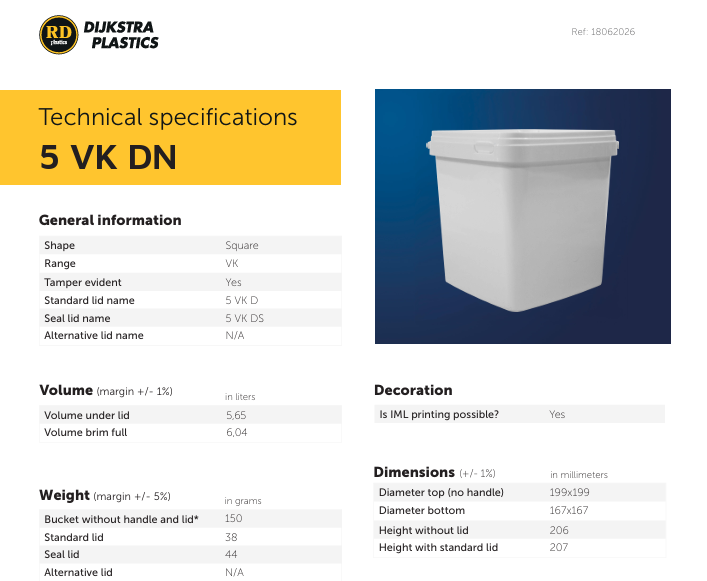
You may already be familiar with our Technical Data Sheets (TDS), which we have used for many years to inform our (prospective) customers about the specifications and capabilities of our packaging buckets.
For the technical information required under the PPWR, we also refer to these Technical Data Sheets. All relevant technical product data can be found in the TDS available on our website, ensuring that our customers always have access to the most up-to-date information.
Our Technical Data Sheets provide general information about the packaging bucket type you purchase from us, including:
- Shape
- Range
- Temper evident
- Standard lid name
- Seal lid name
- Alternative lid name
Our Technical Data Sheets specify the volume of each packaging bucket in litres, based on:
- Under lid
- Brim full
All volume values are specified with a tolerance of ±1%.
Our Technical Data Sheets include the weight of our buckets, lids and handles in grams.
Weight values are specified with a tolerance of ±5%.
Our Technical Data Sheets provide the dimensions of our packaging buckets in millimetres.
Dimensions are specified with a tolerance of ±1%.
Our Technical Data Sheets also provide information about the raw materials used in the production of our packaging buckets.
Bucket
Polypropylene (Virgin PP or PCR PP)
Lid
Polypropylene (Virgin PP or PCR PP)
IML Label
Polypropylene (where applicable)
Handle
Virgin Polypropylene or steel (where applicable)
ARTICLE 6: RECYCLABLE PACKAGING & ARTICLE 7: MINIMUM RECYCLED CONTENT IN PLASTIC PACKAGING
We are currently working on further supporting documentation to provide greater insight into the current recyclability of our packaging buckets and lids.
This does not (yet) constitute an independent study or official certification, but serves as additional supporting information and clarification in preparation for the further requirements and obligations related to Article 6 of the PPWR coming into effect.
From 2030 onwards, the final European criteria and assessment methodology for packaging recyclability will apply.
More information about RecyClass can be found here. You can also download our certificate below.
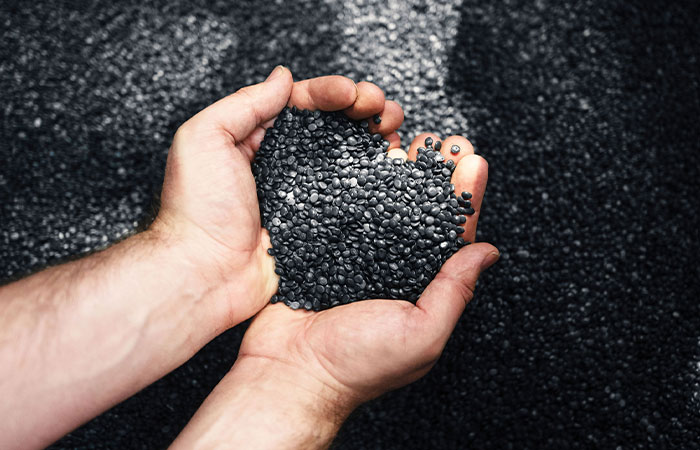
Through our subsidiary FIRE-OFF we have already made it possible well ahead of the PPWR, for used polypropylene (PP) packaging buckets to be collected and recycled into high-quality recycled raw materials. These recycled materials are then used by Dijkstra Plastics to manufacture rPP packaging buckets for the non-food industry.
Further information about FIRE-OFF and its circular initiatives can be found elsewhere on this page.
Although the obligations under Articles 6 and 7 of the PPWR have been established, their practical implementation will be further developed by the European Commission over the coming years. Various delegated and implementing acts will define, among other things, the final design-for-recycling criteria, assessment methodologies and calculation rules.
We are closely monitoring these developments and will continue to update our compliance documentation accordingly.
FREQUENTLY ASKED QUESTIONS (FAQ)
The PPWR introduces obligations that affect manufacturers, suppliers, importers and all other parties throughout the packaging value chain. The impact of these requirements will become increasingly visible over the coming years. Although the obligations differ for each party, we all share responsibility for achieving the PPWR objectives towards 2030.
For us, this means doing everything we can to provide our customers with the information and supporting documentation required to demonstrate conformity, while also sharing our knowledge and expertise throughout the process.
Below, we explain the key topics and articles of the Regulation that are relevant to both us as a packaging supplier and the customers we work with. For the full legal text and official interpretation, we always refer to the PPWR itself. In addition, we explain how we interpret each obligation and the measures we are taking to comply with it.
We are doing everything possible to ensure compliance with the PPWR by 12 August 2026. It is important to understand that there is a distinction between being compliant and having a fully developed compliance dossier.
Our current focus is on ensuring that the minimum required supporting documentation, technical records and declarations are in place so that we can meet our obligations towards our customers.
Above, you will already find the first official documents that can be used as part of your own compliance assessment. Together with our suppliers, we will continue to supplement, verify and update the available declarations and supporting documentation.
As prescribed by Article 16, our responsibility is to provide the information and documentation required to demonstrate the conformity of our packaging and to support the preparation of the corresponding Declaration of Conformity.
As the PPWR compliance date of 12 August 2026 approaches, we are receiving an increasing number of requests regarding the Regulation. Most of these relate to Article 5 – Substances of Concern (SoC), including the requirements concerning heavy metals, PFAS and the associated conformity obligations for manufacturers of packaged products.
Dijkstra Plastics supplies a large number of active customers, the majority of whom are located within Europe. As part of the PPWR, we are currently receiving numerous requests to demonstrate conformity in different ways. These include completing extensive Excel questionnaires, signing customer-specific declarations and providing detailed product data for individual articles.
While we naturally want to support all our customers as effectively as possible, it is not feasible to prepare customised compliance documentation for every individual customer. To ensure a consistent and practical approach, we have chosen to provide the information that falls within our responsibility in a centralised and structured manner. This information can then be used by our customers as part of their own conformity assessment and supporting documentation.
Finally, we would like to emphasise that, both before and after 12 August 2026, we only manufacture packaging that is food-safe and complies with all applicable legislation and regulatory requirements.
Above, you will find the CONFORMITY & SUPPORTING DOCUMENTATION section. From there, you will be guided through the applicable obligations and directed to the documents required to meet the PPWR requirements from 12 August 2026 onwards.
In addition, we provide further information on articles and topics for which there is already significant interest, even though the related obligations are not yet applicable from 12 August 2026, such as Article 6 (Recyclable Packaging) and Article 7 (Minimum Recycled Content in Plastic Packaging).
OBLIGATIONS BY ROLE
Within the PPWR, we do not act as the producer, but as the supplier. We manufacture buckets, but we do not place these packaging products on the market under our own name or brand. The supplier provides packaging or packaging components to other parties within the packaging value chain.
As a supplier, we do have an information obligation. This enables the manufacturer to demonstrate that the packaging and the packaging materials used comply with the applicable legislation.
THE SUPPLIER
The producer is the party responsible for Extended Producer Responsibility (EPR), including registration, reporting, and financing the collection and treatment of packaging waste. In most cases, our customer is the producer of the packaging.
This is typically the party that first places the packaged product on the market in the Member State where the packaging is ultimately expected to become waste. From 12 August 2026 onwards, they must be able to demonstrate that the packaging and the packaging materials used comply with the applicable legislation.
THE PRODUCER
In most cases, our customer is also the manufacturer within the meaning of the PPWR.
The manufacturer is the party responsible for ensuring that the packaging complies with the requirements of the PPWR. The manufacturer prepares the technical documentation and draws up the EU Declaration of Conformity (DoC). For sales packaging, this is typically the party that fills the packaging and places the packaged product on the market under its own name or trademark. The European Commission has clarified that, for sales packaging, the manufacturer will normally be the filler or the brand owner.
THE MANUFACTURER
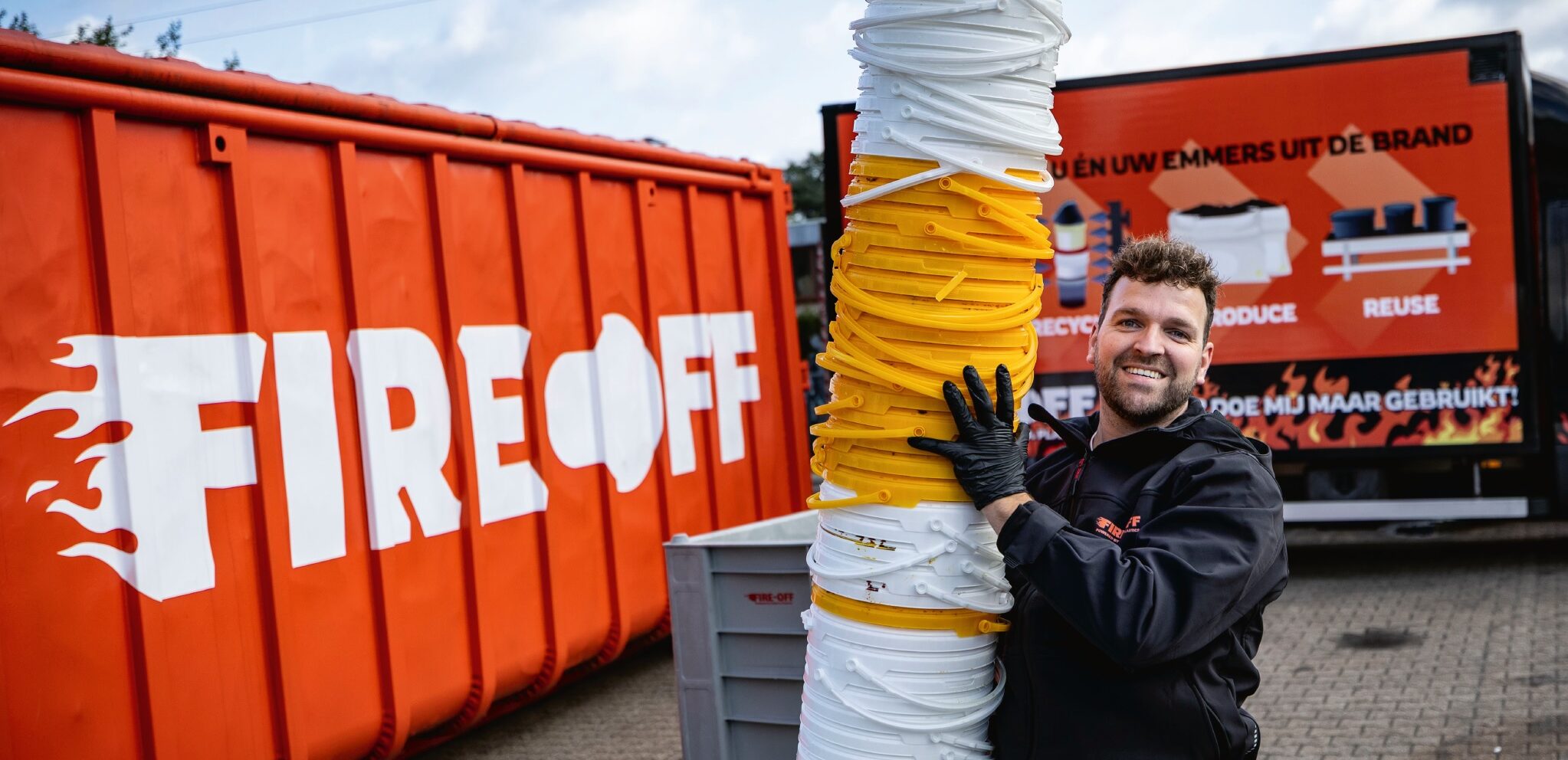
DIJKSTRA PLASTICS X FIRE-OFF: Driving Sustainability in the Packaging Value Chain
The objectives of the PPWR can only be achieved when all parties within the packaging value chain take responsibility. As a producer and supplier of plastic packaging, we develop packaging solutions that align with future requirements relating to recyclability, material efficiency and circularity.
Dijkstra Plastics has been actively committed to these principles for many years. For example, we have been manufacturing pails made from recycled materials for a wide range of applications for more than ten years. With the establishment of our subsidiary FIRE-OFF in 2023, we expanded our activities to include the collection and recycling of used plastic packaging pails.
Even before the publication of the PPWR, we had the ambition to contribute to closing the loop. By gaining practical experience in collection and recycling, we have built valuable expertise that supports the further development of circular packaging solutions.
What does FIRE-OFF do?
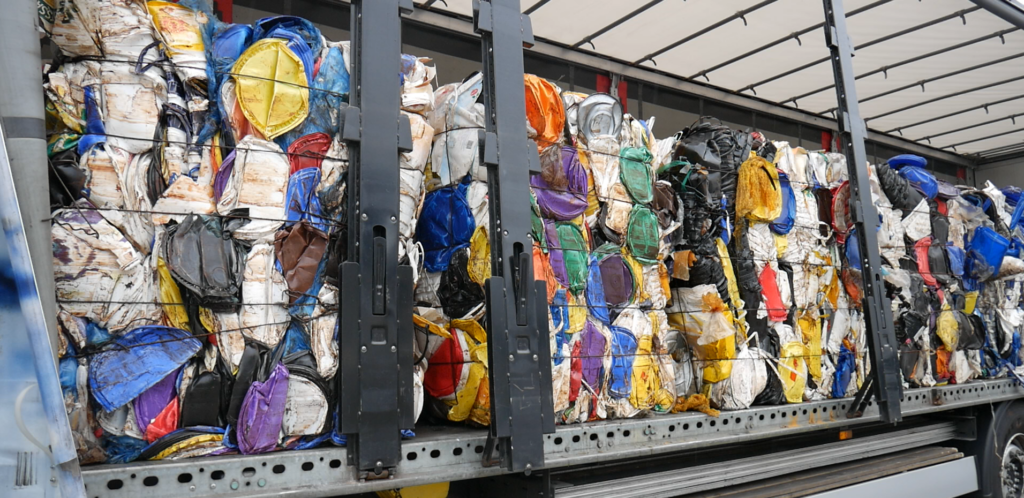
FIRE-OFF collects used plastic packaging pails both within and outside the Netherlands. These packaging materials are sorted, mechanically recycled and reprocessed into raw material for pails made from recycled plastic. In 2025, more than 2.3 million used pails were collected, representing approximately 700,000 kilograms of plastic packaging material.
Through this approach, we are building a high-quality recycling chain in which valuable raw materials are retained and reused for the same type of packaging. This contributes to the circular objectives of the PPWR and reduces dependence on primary fossil-based raw materials.
In the future, we hope to further explore and apply these principles within packaging solutions for the food industry as well.
RELEVANT ARTICLES
“Packaging placed on the market shall be manufactured in such a way that the presence and concentration of substances of concern as constituents of packaging material or packaging components are minimised.”
This also applies to substances released through emissions and waste management processes, such as those found in secondary raw materials, ash or other waste destined for final disposal. It also covers negative environmental impacts caused by microplastics.
PFAS (per- and polyfluoroalkyl substances) must not exceed the following limit values:
- 50 ppm total fluorine (polymeric and non-polymeric PFAS combined)
- 25 ppb for any individual PFAS (polymeric PFAS excluded from quantification)
- 250 ppb for the sum of all PFAS (polymeric PFAS excluded from quantification)
For food contact packaging, packaging containing PFAS above the specified limits may no longer be placed on the market from 12 August 2026 onwards.
For non-food packaging, the PFAS limits set out in Article 5(5) of the PPWR do not apply directly. However, PFAS remain relevant substances of concern under European chemicals legislation, such as REACH and CLP. In addition, the general obligation to minimise the presence of substances of concern in packaging continues to apply.
In the future, the European Commission will monitor the presence of substances of concern. Additional restrictions may be introduced after 2026 if certain additives are found to significantly hinder recycling.
This is only a brief overview of the PPWR requirements regarding substances in packaging (Substances of Concern). For more information, please refer to the full legislation.
As outlined above, the requirements concerning substances in packaging will become applicable from 12 August 2026. With support from FoodChain ID, we are currently collecting the necessary declarations from our food-grade suppliers, including declarations and risk assessments relating to (non-intentionally added) PFAS.
Where a supplier indicates that such substances of concern have been intentionally added, we also request test reports or supporting documentation. In addition, suppliers must indicate whether and how they intend to minimise or phase out these substances in the future. Where possible, we work together with the supplier to phase out these substances. If this proves unfeasible, we investigate alternative suppliers.
Heavy metals
The PPWR establishes limit values for heavy metals in packaging. The combined concentration of lead (Pb), cadmium (Cd), mercury (Hg) and hexavalent chromium (Cr VI) may not exceed 100 mg/kg (100 ppm), calculated as the sum of these four substances in the packaging or packaging component.
With regard to heavy metal concentrations, our packaging has complied with the applicable limits for many years. We are able to substantiate this through supplier declarations.
“1. All packaging placed on the market shall be recyclable.
2. Packaging shall be considered recyclable if it fulfils the following conditions:
(a) it is designed for material recycling, enabling the resulting secondary raw materials to be of sufficient quality to replace primary raw materials; and
(b) once it becomes waste, it can be separately collected in accordance with Article 48(1) and (5), sorted into specific waste streams without negatively affecting the recyclability of other waste streams, and recycled at scale in accordance with the methodology established under paragraph 5 of this Article.”
The ultimate objective is for all packaging placed on the EU market to be genuinely recyclable and recyclable at scale in practice, allowing materials to be used as secondary raw materials instead of new virgin materials.
From 2030, the following recyclability criteria will apply (with further clarification expected in 2028):
Packaging must:
- Be designed for material recycling;
- From 2035 onwards, also be demonstrably collectable, sortable and recyclable at scale;
- Be efficiently sortable into specific material streams;
- Be recyclable into secondary raw materials of sufficient quality to replace primary raw materials.
Recyclability Performance Grades
By early 2028, the European Commission is expected to publish design-for-recycling criteria and recyclability performance grades for each packaging category.
Based on these criteria, packaging will be assessed and classified as Grade A, B or C.
From 2030 onwards, only packaging achieving recyclability grade A, B or C may be placed on the market. The exact assessment methodology and threshold values will be determined by the European Commission.
As a supplier, we support our customers with information regarding the materials used and the recyclability of our packaging. The final assessment procedure and Declaration of Conformity under the PPWR remain the responsibility of the manufacturer placing the packaging on the market.
For our virgin packaging pails, we use only polypropylene (PP) as a raw material. This makes our packaging highly suitable for recycling. Packaging manufactured from recycled polypropylene (rPP) can likewise be recycled again after use.
In previous communications, we referred to recyclability grades and corresponding percentages. As the European Commission has not yet established the final recyclability assessment criteria, we are currently unable and unwilling to assign our packaging to a definitive recyclability grade. Naturally, we remain committed to developing packaging with optimal recyclability.
As the final Design for Recycling (DfR) criteria under the PPWR have not yet been established, we currently base our assessment on the RecyClass Design for Recycling Guidelines. In our information requests to suppliers, we therefore specifically requested information on substances, materials and packaging components that, according to the RecyClass Design for Recycling Guidelines, may have a negative impact on the recyclability of plastic packaging.
What may affect recyclability?
Where a steel handle is used, the recycling process may become somewhat more complex, as the metal must be detected and separated from the plastic stream during sorting and recycling. However, this has little negative impact on the recyclability of the PP pail, lid or steel handle itself. Existing recycling processes can effectively separate and recycle these materials individually.
In addition, our packaging pails can be collected separately and sorted efficiently within existing recycling streams. Wherever possible, we strive for a closed-loop system, in which used PP pails are collected, sorted and recycled before being reused as raw material for pails manufactured from recycled plastic.
Together with FIRE-OFF and other recycling partners, we work towards the highest possible quality recycling of used plastic packaging and the reintroduction of recyclate into new applications.
More information about FIRE-OFF is available at www.fire-off.nl
“By 1 January 2030, or three years from the date of entry into force of the implementing act referred to in paragraph 8 of this Article, whichever is later, any plastic part of packaging placed on the market shall contain a minimum percentage of recycled content recovered from post-consumer plastic waste.
These minimum percentages apply per packaging type and format, as set out in Table 1 of Annex II, and shall be calculated as an annual average per manufacturing plant.”
The objective of Article 7 is to accelerate the transition from virgin plastic to recycled plastic by creating a mandatory market for recyclates, ensuring that plastic packaging becomes part of a circular materials chain.
In addition, the article encourages investment in high-quality plastic recycling, including polypropylene. This enables more plastics to be reused as raw materials for new products, reduces dependence on virgin plastics and lowers both environmental impact and CO₂ emissions.
The obligation applies to the producer placing the filled packaging on the market under its own brand or name. The required percentage of recycled content is calculated as an annual average per manufacturing site.
From 2030, the following minimum percentages have already been established:
- 30% for certain PET packaging;
- 10% for other contact-sensitive plastic packaging;
- 30% for single-use plastic beverage bottles;
- 35% for all other plastic packaging.
These percentages will be increased further by 2040.
Food-to-Food Applications
For food contact packaging, the situation is currently different. Although the PPWR introduces minimum recycled-content requirements from 2030 onwards, there are currently very few approved post-consumer rPP streams that meet European food-contact requirements.
Before 2030, the European Commission will assess the availability of suitable recycling technologies and determine whether exemptions or adapted requirements are needed for specific food-contact applications.
Article 7 covers several areas for which no definitive conclusions can yet be drawn. Important secondary legislation still needs to be adopted. The European Commission is currently developing additional implementing measures regarding the calculation, verification and reporting of recycled content.
However, it is a fact that we have been manufacturing pails from recycled plastic for the non-food sector for more than ten years. As outlined under Article 6, we strive towards a closed-loop system in which plastic packaging is recycled and reused as raw material for new packaging pails.
A significant proportion of our output consists of recycled polypropylene (rPP). The rPP stream we use is certified under the RecyClass Recycled Plastics Traceability Certification.
This already enables our non-food customers to take important steps towards increasing recycled content in their packaging and contributing to a more circular plastics value chain.
Lids made from recycled material
In addition to rPP pails, we are actively expanding the use of lids containing recycled material. Several non-food customers are currently testing these lids in practice and increasing their use where technically and commercially feasible.
We are happy to discuss the possibilities within your specific application.
“By 1 January 2030 at the latest, the manufacturer or importer shall ensure that packaging placed on the market is designed in such a way that its weight and volume are reduced to the minimum necessary to ensure its functionality, taking into account the shape and the material from which the packaging is made.”
Packaging minimisation requirements already exist under the current Packaging Directive. Packaging must not contain more material than is necessary to fulfil its intended function, and the harmonised standard EN 13428:2004 is used to assess compliance. These existing requirements will remain applicable until 31 December 2029.
The PPWR builds upon these requirements and strengthens them further. From 1 January 2030, packaging must be designed so that its weight and volume are reduced to the minimum necessary to perform its intended function. In addition, packaging must not include features that are solely intended to increase the perceived size of a product, such as double walls, false bottoms or unnecessary additional layers.
By 12 February 2027, the European Commission is expected to initiate the development of new harmonised standards for assessing packaging minimisation. These standards should provide greater clarity on how weight, volume, wall thickness and other design aspects are to be evaluated.
For us, this is a relevant article, although we do not expect it to require significant changes. Our packaging is already designed according to the principle that it should contain no more material than necessary to fulfil its intended function. Through technical data sheets, we are able to substantiate the design and material composition of our packaging.
In addition, we offer a range of lightweight packaging solutions. These reduce the weight of pails and lids without compromising quality or performance. Opportunities for further weight reduction vary by application and depend on the requirements placed on the packaging during filling, transport, storage and use.
We continuously look for opportunities to further optimise material usage. The optimisation of secondary and transport packaging is often outside our direct sphere of influence and is primarily the responsibility of the party that assembles and uses these packaging formats.
For more information about our lightweight packaging solutions, please visit: www.rdplastics.nl/lightweight
The PPWR defines reuse as:
“Any operation by which packaging that has been conceived, designed and placed on the market to accomplish multiple trips or rotations within a reuse system is used again for the same purpose for which it was originally conceived. The packaging remains physically the same packaging and is not first recycled into a new raw material.”
Article 11 of the PPWR sets out the conditions that packaging must meet in order to be classified as reusable packaging. Reusable packaging must be designed from the outset for multiple uses and be capable of completing as many rotations as possible under normal conditions of use. In addition, it must meet requirements relating to health, safety and hygiene, be suitable for multiple use cycles and be recyclable at the end of its service life.
Furthermore, by 12 February 2027, the European Commission is expected to establish minimum numbers of rotations for commonly used reusable packaging formats. Packaging that was already placed on the market before 11 February 2025 does not need to be retroactively adapted to meet these requirements. However, the requirements do apply to reusable packaging placed on the market from that date onwards.
Under Article 11, packaging is considered reusable when it has been specifically designed for multiple-use applications.
Packaging pails as supplied by us to the food and non-food industries are equipped with a tamper-evident closure that is broken upon opening. Breaking this seal removes the product guarantee and, to some extent, compromises food safety assurance. For this reason, our products are not designed for reuse.
In our view, the greatest sustainability benefit does not lie in developing reusable packaging, but rather in the high-quality recycling of plastic packaging and the reintroduction of recycled plastics as raw materials for new packaging.
Under the PPWR, this is classified as recycling, not reuse.
Our pails are highly recyclable (Article 6) and therefore represent an important link in the circular plastics value chain.
“From 12 August 2028, or 24 months from the date of entry into force of the implementing acts adopted pursuant to paragraph 6 or paragraph 7 of this Article, whichever is later, packaging placed on the market shall bear a harmonised label providing information on its material composition in order to facilitate consumer sorting.”
Article 12 is currently one of the least defined aspects of the PPWR. The European Commission still needs to establish the exact symbols, design requirements and technical specifications through implementing acts. These are expected by 12 August 2026 at the latest.
It is expected that our packaging pails will fall within the scope of the harmonised labelling requirements. However, it is not yet known which pictograms or symbols will ultimately be required. It is also unclear how this labelling must be applied to the packaging.
The current voluntary material codes and abbreviations, such as PP05, may continue to be used for the time being. These are expected to be replaced in due course by the new harmonised European labelling system.
For this article, it is clear that important implementing rules from the European Commission are still pending. As a result, we are currently unable to specify which symbols, pictograms or markings will ultimately need to be applied to our packaging pails, or what information will be required.
Once further clarification becomes available, we will assess the impact on our products and on the information we provide to our customers.
Until then, we are unable to provide definitive documentation or conformity information relating to the future labelling requirements under Article 12.
Earlier on this page, we explained the different roles within the PPWR value chain.
The PPWR does not only impose obligations on the producer of a packaged product, but on all parties involved in the design, manufacture, supply, import, distribution and handling of packaging. This section outlines the responsibilities of each actor in the value chain to ensure that packaging complies with the requirements of the PPWR.
For Dijkstra Plastics, Article 16 is of particular importance. It states that suppliers of packaging and packaging materials must provide all information and documentation required by the manufacturer to demonstrate the conformity of the packaging. This includes technical data, material information, supplier declarations and other relevant documentation.
Articles 15 through 23 further clarify that each party within the value chain has its own responsibilities. Manufacturers are responsible for the conformity assessment, technical documentation and Declaration of Conformity. Importers and distributors must verify that these obligations have been fulfilled before packaging is placed on the market. In addition, the origin and destination of packaging must be traceable throughout the supply chain.
As a supplier of packaging pails, our responsibility does not lie in preparing the Declaration of Conformity for the packaged product, but in providing the information our customers require to do so.
For this reason, we continuously work on collecting, reviewing and documenting relevant information from our suppliers and throughout our raw material supply chain, enabling our customers to obtain the supporting documentation required to meet their own obligations under the PPWR.
“From 1 January 2030, economic operators using transport packaging or sales packaging used for the transportation of products within the territory of the Union, including products distributed through e-commerce, in the form of pallets, foldable plastic boxes, boxes, trays, plastic crates, intermediate bulk containers, pails, drums and canisters of any size and material, including flexible formats or pallet wraps or straps used for the stabilisation and protection of products placed on pallets during transport, shall ensure that at least 40% of such packaging is reusable within a reuse system.”
In a previous update, it was not yet clear which materials and packaging formats would fall within the scope of the obligations and targets set out in Article 29. Since then, several clarifications have been published.
Article 29 primarily focuses on transport and beverage packaging within reuse systems
The main obligations relate to:
- Transport packaging;
- Shipping packaging;
- Pallets and crates;
- Beverage packaging;
- The hospitality and takeaway sector.
Although pails are explicitly mentioned in Article 29, this does not automatically mean that every plastic pail falls under the reuse targets. Most plastic pails used in food and non-food applications are classified as sales packaging. These packaging formats are generally designed for single use, after which they are collected and recycled. For such applications, the direct impact of Article 29 is currently limited.
Packaging cannot simply be classified as “reusable”
When packaging is placed on the market as reusable packaging, it must comply with the requirements of Article 11. The packaging must be designed for multiple rotations within a reuse system and be technically suitable for repeated use.
Member States may introduce additional reuse targets
Under certain conditions, Article 29 allows Member States to introduce additional or higher reuse targets where necessary to achieve national waste reduction objectives. Such measures must not create unnecessary barriers to the internal market.
At present, Article 29 has limited direct impact on our standard packaging pails. Our PP and rPP pails have been developed as high-quality, recyclable sales packaging and are not intended for use within an official reuse system.
For this reason, our primary focus remains on:
- Recyclability (Article 6);
- The use of recycled content (Article 7);
- Packaging minimisation (Article 10);
- Conformity and documentation (Articles 15 and 16).
Should customers choose to implement an official reuse system in the future, involving return logistics and multiple rotations, the packaging will need to comply with the specific requirements for reusable packaging under Article 11 and the reuse provisions set out in Article 29.
